How to Do Keyword Research for SEO: A Complete Beginner’s Guide
Imagine spending days writing an article that never appears on Google. The content is well written, the design looks professional, and you genuinely believe it can help readers. Yet weeks pass, and your page receives little or no traffic.
This is one of the most common frustrations for bloggers, business owners, and marketers. In many cases, the problem isn’t the quality of the content—it’s choosing the wrong keywords.
Learning how to do keyword research for SEO is one of the most valuable skills in digital marketing. Keyword research helps you understand what your audience is searching for, how competitive those searches are, and which topics offer the best opportunity to attract organic traffic.

Rather than guessing what people want, keyword research allows you to make decisions based on real search behaviour. It forms the foundation of successful SEO, content marketing, local SEO, e-commerce optimisation, and even paid advertising.
Whether you’re launching a new website, growing a blog, or promoting an online business, choosing the right keywords can help you:
- Attract highly targeted visitors
- Increase your Google rankings
- Generate more qualified leads
- Improve website authority
- Create content your audience genuinely wants to read
In this comprehensive guide, you’ll learn the complete keyword research process—from understanding search intent and finding low-competition keywords to using professional keyword research tools and building an effective content strategy.
By the end of this article, you’ll have a practical framework that you can apply immediately to improve your SEO performance.
Table of Contents
What Is Keyword Research?
Keyword research is the process of discovering the words and phrases people type into search engines like Google when looking for information, products, or services.
These search terms are known as keywords.
Instead of creating content based on assumptions, keyword research enables you to identify topics that real users are actively searching for.
For example, suppose you own a bakery in Lahore.
You could write an article titled:
“Our Favourite Cakes”
However, keyword research may reveal that people are actually searching for:
- Best birthday cakes in Lahore
- Custom wedding cakes Lahore
- Chocolate cake delivery Lahore
The second approach aligns your content with user demand, making it far more likely to attract visitors from search engines.
Think of keyword research as listening to your customers before creating your content. It helps you answer the questions they are already asking.
Keyword Research in Simple Terms
| Without Keyword Research | With Keyword Research |
|---|---|
| Guess what people want | Know what people search |
| Low traffic | Targeted traffic |
| Poor rankings | Better SEO opportunities |
| Random content | Strategic content plan |
| Difficult to grow | Sustainable organic growth |
Why Keyword Research Matters for SEO
Search engines aim to provide users with the most relevant answers to their questions.
If your content matches what people are searching for, Google is more likely to display your page in the search results.
Keyword research helps bridge the gap between your content and your audience’s needs.
Benefits of Keyword Research
1. Understand Your Audience
Keyword research reveals the language your customers actually use.
For instance, a business may promote “wireless audio devices”, while users search for “Bluetooth earbuds”. Using the audience’s terminology improves the relevance and discoverability of your content.
2. Increase Organic Traffic
Targeting relevant keywords means your content can appear when users are actively searching for solutions.
This brings visitors who are already interested in your topic, resulting in higher-quality traffic.
3. Discover Content Ideas
Running out of blog ideas is common.
Keyword research provides an endless source of content opportunities based on real search demand.
For example, one keyword can inspire multiple articles:
- What is keyword research?
- Keyword research checklist
- Free keyword research tools
- Common keyword research mistakes
- Keyword research for local SEO
- Keyword research for e-commerce
4. Improve Conversion Rates
Ranking isn’t enough.
The right keywords attract visitors who are more likely to become customers.
Someone searching:
“Buy running shoes online.”
is much closer to making a purchase than someone searching:
“History of shoes”
Choosing keywords with the right intent helps improve business results.
5. Stay Ahead of Competitors
Your competitors are already targeting valuable keywords.
Keyword research helps you identify opportunities they may have overlooked, particularly long-tail keywords with lower competition.
Expert Tip
Focus on solving real user problems rather than simply chasing high search volume. A keyword with fewer searches but stronger intent often delivers better traffic and conversions than a broad, highly competitive term.
Understanding Search Intent
One of the biggest mistakes beginners make is focusing only on search volume.
Search intent—the reason behind a search—is just as important.
Google tries to understand what users actually want, not just the words they type.
There are four primary types of search intent.
| Search Intent | Purpose | Example |
|---|---|---|
| Informational | Learn something | How to do keyword research for SEO |
| Navigational | Find a specific website | Google Search Console |
| Commercial Investigation | Compare options before buying | Best keyword research tools |
| Transactional | Ready to take action | Buy SEO software |
When your content matches the user’s intent, it has a much better chance of ranking well.
Example
Imagine someone searches:
“Best keyword research tools.”
If your page explains only what keyword research is, it won’t fully satisfy the searcher’s needs.
Instead, they expect:
- Tool comparisons
- Pricing
- Features
- Pros and cons
- Recommendations
Matching search intent is one of the strongest ranking signals in modern SEO.
Quick Summary
Before creating any piece of content, ask yourself:
- What question is the user trying to answer?
- What problem are they trying to solve?
- What action do they want to take afterwards?
- Does my content fully satisfy that need?
If the answer is yes, you’re already following one of the most effective SEO practices.
Different Types of Keywords
Not all keywords are created equal. Understanding the different types of keywords will help you build a balanced SEO strategy that attracts the right audience at every stage of their journey.

1. Short-Tail Keywords
Short-tail keywords are broad search terms, usually consisting of one or two words.
Examples:
- SEO
- Keyword research
- Digital marketing
Advantages
- High search volume
- Broad audience reach
Disadvantages
- Extremely competitive
- Lower conversion rates
- Difficult for new websites to rank
Example: Ranking for “SEO” is much harder than ranking for “how to do keyword research for SEO.”
2. Long-Tail Keywords
Long-tail keywords are longer, more specific phrases, typically containing three or more words.
Examples:
- How to do keyword research for SEO
- Best keyword research tools for beginners
- Find low competition keywords for a new website
These keywords usually have:
- Lower competition
- Higher conversion potential
- Clearer search intent
For new websites, long-tail keywords are often the smartest place to start.
3. Informational Keywords
These are used by people who want to learn something.
Examples:
- What is SEO?
- How does Google rank websites?
- Keyword research process
These keywords are ideal for blog posts, tutorials, and educational content.
4. Commercial Keywords
Users are researching products or services before making a decision.
Examples:
- Best keyword research tools
- Ahrefs vs Semrush
- Best SEO agency for small businesses
These keywords are valuable for comparison articles and service pages.
5. Transactional Keywords
These indicate that a user is ready to take action.
Examples:
- Buy SEO course
- Hire SEO expert
- SEO services near me
These keywords are best suited for landing pages and service pages.
Keyword Types at a Glance
| Keyword Type | Example | Competition | Conversion Potential |
|---|---|---|---|
| Short-tail | SEO | Very High | Low |
| Long-tail | How to do keyword research for SEO | Medium to Low | High |
| Informational | What is keyword research? | Medium | Medium |
| Commercial | Best keyword research tools | High | High |
| Transactional | Hire SEO agency | High | Very High |
How to Do Keyword Research for SEO: The Step-by-Step Process
Now let’s walk through a practical, step-by-step process you can follow for any website.
Step 1: Understand Your Audience
Before opening any keyword research tool, think about your ideal visitor.
Ask yourself:
- Who are they?
- What problems do they face?
- What questions might they ask Google?
- What solutions are they looking for?
For PakNook, the audience includes:
- Small business owners
- Bloggers
- Entrepreneurs
- Marketing professionals
- Beginners learning SEO
Understanding your audience helps you create content that truly meets their needs.
Step 2: Brainstorm Seed Keywords
Seed keywords are the starting point for your research.
They describe your main products, services, or topics.
Example seed keywords for PakNook:
- SEO
- Keyword research
- Content writing
- Digital marketing
- WordPress
- Local SEO
- Google Search Console
These broad terms will help you discover hundreds of related keyword ideas.
Pro Tip: Don’t worry about search volume at this stage. Focus on listing every relevant topic.
Step 3: Use Keyword Research Tools
Enter your seed keywords into a keyword research tool to uncover valuable data.
Look for:
- Monthly search volume
- Keyword difficulty
- Cost per click (CPC)
- Related keywords
- Questions people ask
- Long-tail keyword suggestions
Popular keyword research tools include:
- Google Keyword Planner
- Google Search Console
- Ahrefs
- Semrush
- Moz Keyword Explorer
- Ubersuggest
Step 4: Analyse Search Intent
Every keyword reflects a user’s goal.
Ask:
- Do they want information?
- Are they comparing options?
- Are they ready to buy?
- Are they looking for a specific website?
Create content that directly addresses that intent.
For example:
Keyword: “Google Keyword Planner tutorial”
The searcher expects:
- A step-by-step guide
- Screenshots or visuals
- Practical examples
- Tips for beginners
A general article about SEO won’t satisfy this search.
Step 5: Check Search Volume
Search volume tells you how often a keyword is searched each month.
However, don’t chase only high-volume keywords.
A keyword with:
- 200 monthly searches
- Low competition
- Strong buying intent
can be more valuable than a keyword with:
- 20,000 searches
- Extremely high competition
Focus on relevance and intent first.
Step 6: Evaluate Keyword Difficulty
Keyword difficulty estimates how challenging it is to rank for a keyword.
Generally:
| Difficulty | Recommendation |
|---|---|
| Low | Excellent for new websites |
| Medium | Good if you have quality content |
| High | Target after building authority |
For a relatively new website, prioritise low-competition opportunities.
How to Find Low-Competition Keywords
One of the fastest ways to grow organic traffic is by targeting keywords that larger competitors overlook.
Strategies to Find Low-Competition Keywords
Target Long-Tail Keywords
Instead of:
- SEO
Try:
- SEO tips for beginners
- How to improve SEO rankings with keywords
- Keyword research for local businesses
Specific keywords often have less competition and attract more qualified visitors.
Use Google’s Autocomplete
Start typing a keyword into Google and note the suggested searches.
These suggestions are based on real user searches and can reveal valuable content ideas.
Explore “People Also Ask”
The “People Also Ask” section is a goldmine for discovering related questions.
Each question can become:
- A new blog post
- An FAQ
- A heading within an article
Answering these questions increases your chances of appearing in featured snippets.
Look at Related Searches
Scroll to the bottom of the search results page.
Google’s related searches often reveal additional long-tail keyword opportunities.
Focus on Specific Niches
Rather than writing broad articles about SEO, narrow your focus.
Examples:
- Keyword research for restaurants
- Keyword research for dentists
- Keyword research for e-commerce stores
- Keyword research for local businesses
Specific niches usually have lower competition and a more targeted audience.
Example: Finding a Better Keyword
Imagine you’re writing about SEO.
Option A
Keyword:
SEO
Competition:
Very High
Difficulty:
Extremely difficult for a new website.
Option B
Keyword:
How to do keyword research for SEO for beginners
Competition:
Much Lower
Search Intent:
Highly focused
Audience:
Beginners actively looking for guidance
This keyword is a much stronger target for a newer site because it aligns with user intent and is more achievable.
Beginner’s Keyword Research Checklist
Before choosing any keyword, ask yourself:
- Is it relevant to my audience?
- Does it match the user’s search intent?
- Can I create content that is better than the current top results?
- Is the competition realistic for my website?
- Can I naturally include related keywords?
- Does it support my business goals?
If you answer “yes” to most of these questions, the keyword is likely worth targeting.
Common Mistakes to Avoid
Even experienced marketers can make mistakes during keyword research. Avoid these common pitfalls:
- Choosing keywords based only on search volume.
- Ignoring search intent.
- Targeting highly competitive keywords too early.
- Forgetting to optimise for long-tail keywords.
- Creating multiple pages targeting the same keyword (keyword cannibalisation).
- Failing to update keyword research as trends change.
- Not analysing competitors before creating content.
Expert Tip: A smaller keyword with strong intent often delivers more business value than a popular keyword with vague intent. Always prioritise usefulness over vanity metrics.
Quick Summary
By now, you should understand:
- The main types of keywords.
- Why long-tail keywords are valuable.
- How to begin the keyword research process.
- How to evaluate search volume and competition.
- Practical ways to uncover low-competition opportunities.
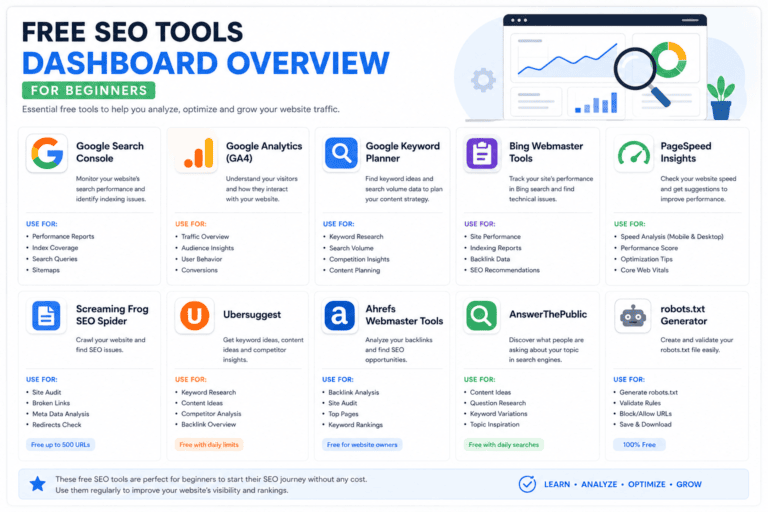
Best Keyword Research Tools (Free & Paid)
The right keyword research tool can save hours of manual work. While no single tool is perfect, each one has its strengths. Beginners can start with free options and upgrade to premium tools as their website grows.
Free vs Paid Keyword Research Tools
| Tool | Free Version | Best For | Beginner Friendly |
|---|---|---|---|
| Google Keyword Planner | ✅ Yes | Search volume & keyword ideas | ⭐⭐⭐⭐⭐ |
| Google Search Console | ✅ Yes | Existing keyword performance | ⭐⭐⭐⭐⭐ |
| Google Trends | ✅ Yes | Seasonal trends | ⭐⭐⭐⭐⭐ |
| Ahrefs | Limited Free Tools | Competitor analysis | ⭐⭐⭐⭐ |
| Semrush | Limited Free | Comprehensive SEO | ⭐⭐⭐⭐ |
| Moz Keyword Explorer | Limited Free | Keyword difficulty | ⭐⭐⭐⭐ |
| Ubersuggest | Limited Free | Beginners | ⭐⭐⭐⭐⭐ |
| AnswerThePublic | Limited Free | Content ideas & questions | ⭐⭐⭐⭐ |
Pro Tip: You don’t need expensive tools on day one. Google’s free tools are powerful enough to build a solid SEO strategy.
Google Keyword Planner Tutorial
Google Keyword Planner is one of the most trusted tools because the data comes directly from Google Ads. Even if you don’t plan to run advertisements, it’s an excellent starting point for keyword research.
Step 1: Create a Google Ads Account
Sign in with your Google account and access Keyword Planner through the Google Ads dashboard. You don’t need to launch an advertising campaign to use the tool.
Step 2: Choose “Discover New Keywords”
Enter one or more seed keywords, such as:
- keyword research
- SEO
- digital marketing
- content writing
Google will generate hundreds of related keyword ideas.
Step 3: Review the Results
For each keyword, you’ll typically see:
- Average monthly searches
- Competition level
- Estimated cost per click (CPC)
- Related keyword suggestions
Your goal isn’t simply to pick the keyword with the highest search volume. Instead, look for a balance between relevance, search demand, and achievable competition.
Step 4: Filter Your Results
Use filters to narrow down the list by:
- Language
- Country
- Search volume
- Competition level
- Included or excluded words
This helps you focus on keywords that are most relevant to your audience.
Step 5: Export Your Keywords
Download the results into a spreadsheet. This allows you to organise, prioritise, and plan your content more effectively.
How to Analyse Competitor Keywords
One of the quickest ways to discover keyword opportunities is by studying websites that already rank well in your niche.
Step 1: Identify Your Competitors
Search your target keyword on Google and note the websites appearing on the first page.
For example, if your keyword is “SEO keyword research”, you might find well-known industry blogs and educational resources.
Step 2: Review Their Content
Pay attention to:
- Headings
- Subheadings
- Frequently asked questions
- Internal links
- Content depth
- Images and examples
Ask yourself:
- What topics have they covered?
- What information is missing?
- How could I provide more value?
Step 3: Discover Their Ranking Keywords
Tools such as Ahrefs, Semrush, and Moz can reveal many of the keywords a competitor ranks for.
Look for:
- Keywords with moderate search volume
- Lower competition
- Relevant user intent
- Opportunities they haven’t fully covered
Step 4: Create Better Content
Rather than copying competitors, aim to improve on what already exists.
You can add:
- More detailed explanations
- Updated information
- Practical examples
- Better formatting
- Helpful visuals
- Checklists
- FAQs
Google rewards content that provides greater value and a better user experience.
Organising Keywords into Topic Clusters
Publishing isolated blog posts can make it harder for search engines to understand your website’s expertise.
Instead, group related topics into clusters around a central “pillar” page.
Example for PakNook
Pillar Page
How to Do Keyword Research for SEO
Supporting articles might include:
- Best Free Keyword Research Tools
- Google Keyword Planner Tutorial
- Long-Tail Keywords Explained
- Common Keyword Research Mistakes
- How to Find Low-Competition Keywords
- Keyword Research for Local SEO
- Keyword Research for E-commerce Websites
- Beginner’s Guide to Search Intent
Each supporting article should link back to the pillar page, and the pillar page should link to each supporting article. This internal linking structure helps both users and search engines navigate your content.
Create a Keyword Research Spreadsheet
Keeping your research organised is just as important as finding the right keywords.
Recommended Spreadsheet Columns
| Column | Purpose |
|---|---|
| Target Keyword | Main keyword |
| Search Intent | Informational, Commercial, etc. |
| Search Volume | Monthly searches |
| Keyword Difficulty | Ranking difficulty |
| CPC | Commercial value |
| Content Type | Blog, Landing Page, Service Page |
| Target URL | Planned page |
| Status | Planned, Draft, Published |
| Notes | Additional observations |
Updating this spreadsheet regularly helps you avoid duplicate content and maintain a clear content strategy.
Advanced Keyword Research Strategies
Once you’re comfortable with the basics, consider these advanced techniques.
1. Optimise for Question-Based Searches
Many users search in the form of questions.
Examples:
- What is keyword research?
- Why is keyword research important?
- How do I find low-competition keywords?
Including these questions as headings or FAQs can improve your chances of appearing in featured snippets.
2. Target Related Keywords
Google understands context, so don’t rely solely on one exact keyword.
Naturally include related phrases such as:
- SEO keyword research
- keyword research tools
- search intent
- organic traffic
- content strategy
- search engine optimisation
This strengthens topical relevance without keyword stuffing.
3. Update Existing Content
SEO isn’t a one-time task.
Regularly review older articles to:
- Add new keywords
- Refresh outdated information
- Improve internal linking
- Expand thin sections
- Update screenshots or examples
Fresh content often performs better over time.
4. Focus on User Experience
Even the best keyword strategy won’t succeed if users leave your page quickly.
Ensure your content is:
- Easy to read
- Well structured
- Mobile friendly
- Fast loading
- Helpful and trustworthy
A positive user experience supports stronger SEO performance.
Expert Tips
Expert Tip #1: Start with keywords that match your website’s authority. New websites should prioritise low-competition, long-tail keywords.
Expert Tip #2: Build topical authority by publishing multiple high-quality articles around one subject instead of writing about unrelated topics.
Expert Tip #3: Review your keyword strategy every three to six months. Search trends and user behaviour change over time.
Key Takeaways So Far
- Keyword research begins with understanding your audience.
- Long-tail keywords are often the best opportunity for new websites.
- Google Keyword Planner and Search Console are excellent free tools.
- Competitor analysis can uncover valuable keyword opportunities.
- Organising keywords into topic clusters strengthens topical authority.
- A well-maintained keyword spreadsheet keeps your content strategy focused.
- User intent should guide every content decision.
Frequently Asked Questions (FAQs)
1. What is keyword research in SEO?
Keyword research is the process of finding the words and phrases people use when searching on Google and other search engines. It helps you create content that matches user intent and improves your chances of ranking higher.
2. Why is keyword research important?
Keyword research helps you:
- Understand your audience
- Create relevant content
- Increase organic traffic
- Improve search engine rankings
- Generate more leads and sales
Without keyword research, you’re essentially guessing what your audience wants.
3. What are long-tail keywords?
Long-tail keywords are longer, more specific search phrases, such as “how to do keyword research for SEO for beginners”. They typically have lower competition and attract users with clearer intent, making them ideal for new websites.
4. Which free keyword research tool is best?
Some of the best free options include:
- Google Keyword Planner
- Google Search Console
- Google Trends
- AnswerThePublic (limited free version)
- Ubersuggest (limited free version)
For beginners, Google Keyword Planner and Google Search Console are excellent starting points.
5. How many keywords should I target in one article?
Focus on:
- 1 primary keyword
- 5–10 closely related secondary keywords
Use them naturally throughout the content. Avoid keyword stuffing, as it can harm readability and SEO.
6. How often should I do keyword research?
Review your keyword strategy every 3–6 months, or sooner if:
- Your industry changes rapidly
- Google updates its search algorithms
- You launch new products or services
- You notice declining traffic
Regular updates help keep your content relevant.
7. Can I rank without keyword research?
It’s possible, but much less likely. Keyword research helps align your content with what people are actively searching for, significantly improving your chances of earning organic traffic.
8. What’s the difference between search volume and keyword difficulty?
- Search Volume: The estimated number of monthly searches for a keyword.
- Keyword Difficulty: An estimate of how hard it is to rank for that keyword.
A keyword with moderate search volume and low difficulty is often a better target than a high-volume, highly competitive keyword.
9. How do I avoid keyword cannibalisation?
Keyword cannibalisation happens when multiple pages on your site target the same primary keyword. Prevent it by:
- Assigning one primary keyword to each page.
- Creating a content plan before publishing.
- Using internal links to connect related articles.
10. Is keyword research only for blog posts?
No. Keyword research benefits:
- Service pages
- Product pages
- Landing pages
- Category pages
- FAQs
- Videos
- YouTube descriptions
- Local SEO pages
Any content intended to appear in search results should be informed by keyword research.
Quick Summary Box
What You’ve Learned
By following this guide, you now know how to:
- Understand search intent before creating content.
- Find relevant keyword ideas.
- Use free and paid keyword research tools.
- Identify low-competition keyword opportunities.
- Analyse competitor strategies.
- Build topic clusters and content silos.
- Organise keywords in a spreadsheet.
- Create content that matches user needs.
- Improve SEO rankings through strategic keyword targeting.
Keyword research isn’t just about rankings—it’s about understanding your audience and delivering the content they’re looking for.
Common Mistakes to Avoid
Even experienced marketers can make these mistakes. Keep this checklist handy:
- ❌ Choosing keywords based only on search volume.
- ❌ Ignoring user intent.
- ❌ Targeting highly competitive keywords too early.
- ❌ Publishing multiple pages targeting the same keyword.
- ❌ Neglecting long-tail keywords.
- ❌ Failing to update old content.
- ❌ Overusing keywords (keyword stuffing).
- ❌ Forgetting to monitor performance in Google Search Console.
Avoiding these pitfalls will help you build a stronger, more sustainable SEO strategy.
Final Thoughts
Keyword research is the foundation of every successful SEO campaign. It helps you understand what your audience is searching for, uncover opportunities your competitors may have missed, and create content that answers real questions.
Remember that effective keyword research isn’t about finding the biggest keywords—it’s about finding the right keywords. Prioritise relevance, search intent, and achievable competition over vanity metrics.
As your website grows, revisit your keyword strategy regularly. Search behaviour evolves, industries change, and new opportunities appear. By staying consistent and focusing on helpful, high-quality content, you’ll build lasting organic visibility and trust with both users and search engines.
Ready to Grow Your Website?
If you’d like expert assistance with:
- SEO keyword research
- Content strategy
- On-page SEO
- Content writing
- Technical SEO
- WordPress optimisation
- Local SEO
- Digital marketing
PakNook is here to help. Our goal is to create SEO strategies and high-quality content that help businesses attract the right audience and achieve sustainable growth.
Get in touch with PakNook today to discuss how a tailored SEO strategy can support your business goals.