Why Social Media Marketing Is Important in 2026 (And What Happens If You Ignore It)
Table of Contents
Introduction: Let’s Be Honest for a Second
Here’s a question worth sitting with for a moment — when was the last time you made a buying decision without first checking a brand’s Instagram, scrolling through their reviews, or watching a quick TikTok about them?
Probably not recently.
Understanding why social media marketing is important has never been more urgent for businesses.
That’s not a coincidence. That’s a complete shift in the way the world discovers, trusts, and buys from businesses. And if your brand isn’t showing up in those spaces — consistently and compellingly — you’re not just missing opportunities. You’re handing them directly to your competitors.
Social media marketing has moved far beyond posting pretty pictures and hoping for likes. Today, it’s one of the most powerful business tools available, and it works for everyone — from solo creators and small local shops to global enterprises running multi-million-dollar campaigns.
In this article, we’re going to break down exactly why social media marketing is important, what it actually does for your business, and why the brands investing in it right now are the ones everyone else will be trying to catch up with in a few years.
Let’s get into it.
Why Social Media Marketing Is Important — The Numbers Prove It
Before we get into the strategy and the “why”, let’s ground ourselves in the reality of what social media looks like right now.
There are over 5.2 billion active social media users globally as of 2026. That’s more than half the planet. People spend an average of 2 hours and 23 minutes per day scrolling, engaging, sharing, and — yes — shopping on social platforms.
Let that sink in. Two-plus hours, every single day, from billions of people.
Platforms like Instagram, TikTok, YouTube, Facebook, LinkedIn, and Pinterest aren’t just places people go to kill time anymore. They’re digital ecosystems where communities form, trends are born, careers are built, and products sell – sometimes within hours of being introduced.
For businesses, this is not background noise. This is prime real estate.
1. It Puts Your Brand Right Where Your Audience Already Is
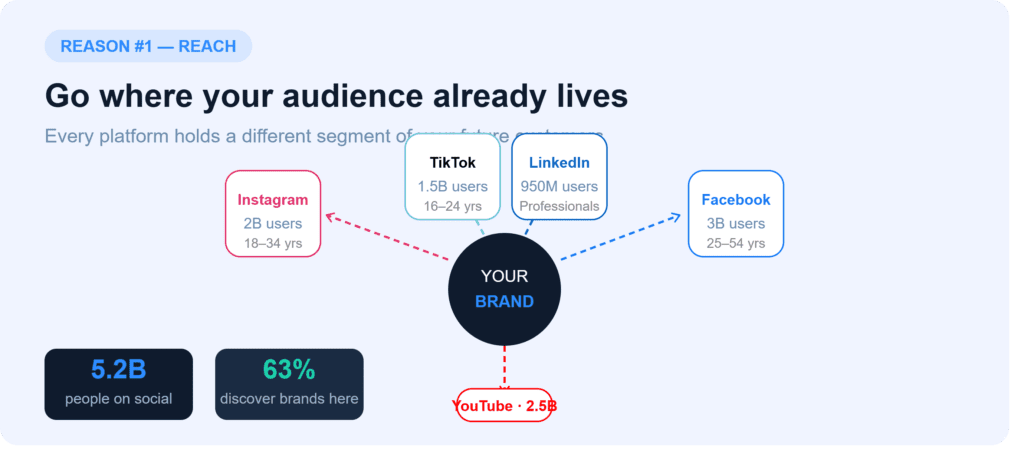
One of the oldest rules in marketing is simple: go where your people are. And in 2026, your people are on social media. All of them. The 22-year-old college student, the 45-year-old homeowner, the retired professional — they all have at least one platform they check daily.
What social media marketing allows you to do is meet your audience in a space that already feels comfortable and familiar to them. You’re not interrupting their day with a cold call or hoping they stumble onto your website. You’re showing up organically in their feed – alongside content from their friends, family, and favourite creators.
When done well, your brand feels less like an advertisement and more like a natural part of their scroll. That’s a level of access and familiarity that traditional advertising simply cannot replicate.
2. Brand Awareness Grows Faster Than Almost Any Other Channel
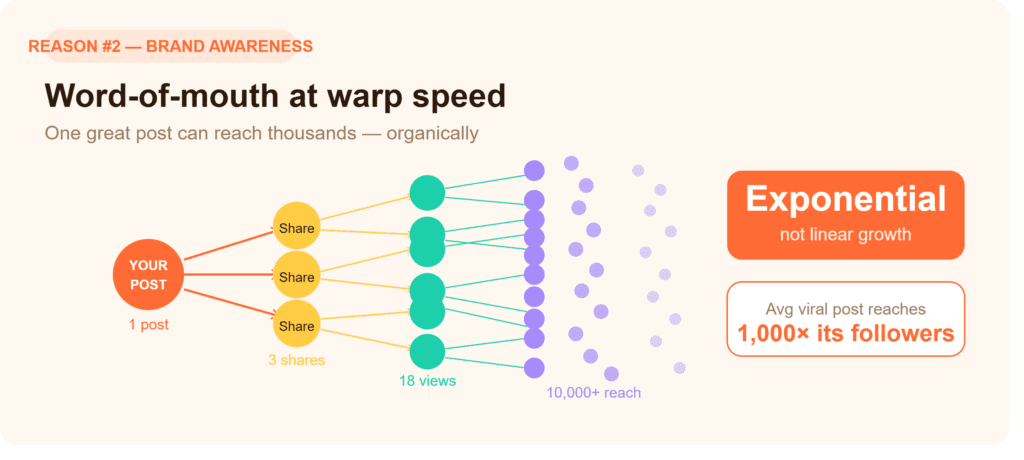
Think about how word-of-mouth worked before the internet. Someone liked your product and told three friends, who maybe told three more. It was slow, uncontrollable, and hard to scale.
Social media is word-of-mouth at warp speed.
A single post — if it resonates — can be shared thousands of times in a matter of hours. A well-timed reel, an honest review from a micro-influencer, or a post that taps into a trending conversation can introduce your brand to tens of thousands of people who had never heard of you before that morning.
This is why social media marketing is so uniquely powerful for brand awareness. It gives you the potential for exponential reach. Not linear growth — exponential. And you don’t always need a massive budget to achieve it. Sometimes, the most effective content is the most authentic.
A scrappy behind-the-scenes video shot on a phone can outperform a polished campaign that costs ten times as much to produce. The algorithm rewards resonance, not necessarily production value.
3. You Can Actually Target the Exact Right People
Here’s something that still feels like a bit of magic: the ability to put your message in front of someone based on their age, location, income bracket, interests, job title, online behaviour, and even the life events they’re going through.
Social media advertising platforms – Facebook Ads, Instagram Ads, TikTok Ads, LinkedIn Ads — offer targeting capabilities that make traditional media look like throwing darts blindfolded.
Want to reach women between 28 and 40 who live in Chicago, are interested in home renovation, and recently got engaged? You can do that. Want to target startup founders in the tech sector with more than 50 employees? LinkedIn will hand you that audience on a silver platter.
This precision is a game-changer, especially for businesses with limited budgets. Instead of broadcasting to millions and hoping the right people notice, you’re speaking directly to the exact people most likely to care about what you offer.
Less waste. More results.
4. It Humanizes Your Brand in a Way That Nothing Else Can
People don’t connect with logos. They connect with stories, personalities, and values.
Social media gives you a stage to show the human side of your business — the founder who stayed up until 2 am perfecting a product, the team that actually cares about customer feedback, and the values that drive every decision you make.
When followers see your team celebrating a milestone, responding to comments, sharing the lessons you learned from a mistake, or posting something genuinely funny and on-brand — they feel something. And that feeling is called trust.
Trust is the currency of modern marketing. It takes time to build, it’s easy to lose, and brands that have it enjoy a loyalty that paid advertising simply cannot buy. Social media, when used authentically, is one of the fastest ways to build that trust at scale.
5. It Drives Real, Measurable Business Results
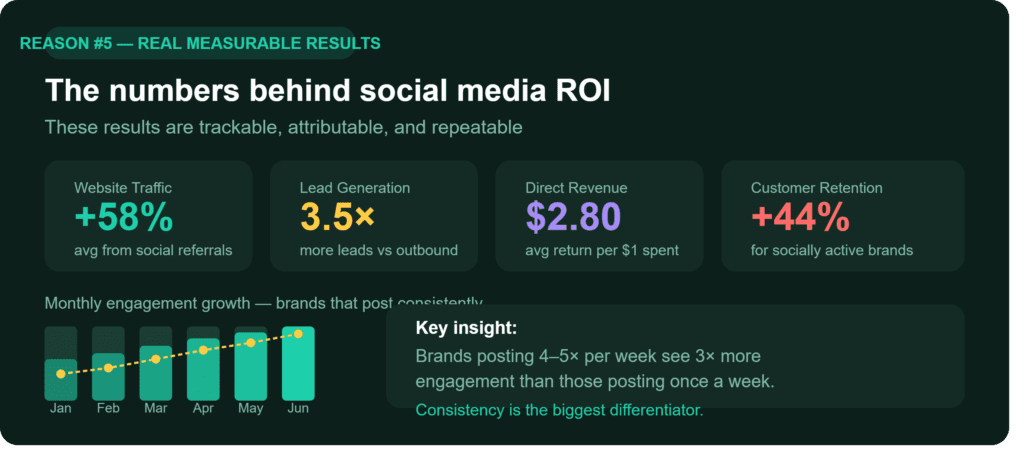
Let’s clear up a common misconception: social media marketing is not just about vanity metrics. Likes and followers are nice, but the real story is in the business results.
This is exactly why social media marketing is important — it connects directly to your bottom line.
Done right, social media drives:
- Website traffic — Every link in bio, story swipe-up, or pinned post can funnel people directly to your offers.
- Lead generation — Platforms now offer built-in lead forms, making it easier than ever to capture contact information without people even leaving the app.
- Direct sales — With features like Instagram Shopping, TikTok Shop, and Facebook Marketplace, social platforms have become genuine shopfronts.
- Email list growth — Social content can serve as the top of a funnel that feeds your owned marketing channels.
- Customer retention — Staying visible to existing customers keeps you top of mind and reduces churn.
The key is having a strategy. Showing up randomly and hoping for results is not a strategy. But when your content is intentional, your calls-to-action are clear, and you’re tracking what’s working, the ROI of social media marketing becomes very measurable and very real.
6. Your Competitors Are Already There (Seriously)
This one should be enough on its own.
Regardless of your industry, your competitors are on social media. And if you’re not there with them – actively publishing content, building an audience, running ads – you are invisible to every potential customer who discovers your niche through those channels.
Worse, the longer you wait, the bigger the gap becomes. The brand that started building its Instagram following three years ago has a compounding advantage over the brand that starts today. Audiences, engagement history, and algorithmic trust all accumulate over time.
Every day you’re not on social media is a day your competitors are talking to your future customers.
7. Customer Service Has Moved to Social Media — Whether You Like It or Not
Here’s something a lot of businesses don’t fully appreciate: people are already talking about you on social media, even if you’re not there.
They’re asking questions on Twitter. They’re leaving feedback in comment sections. They’re tagging brands in stories, posts, and videos. If a customer has a complaint, an expectation, or a compliment, there’s a very good chance their first instinct is to share it publicly online.
If you’re not monitoring and engaging, those conversations happen without you. Bad experiences go unaddressed. Questions go unanswered. And the opportunity to turn a frustrated customer into a loyal advocate disappears.
When you show up actively — responding promptly, solving problems publicly, and acknowledging feedback with grace — you do something remarkable. You show every person watching that you actually care. And that reputation for responsiveness and accountability? It’s worth more than any advertisement.
8. Content You Create Lives On and Keeps Working for You
One of the underrated advantages of social media content is its longevity.
A well-optimised YouTube video can generate views, leads, and sales for years. A Pinterest graphic can circulate and drive traffic long after you hit publish. A LinkedIn article can resurface in search results for months. Even short-form content on TikTok or Instagram Reels gets replayed, shared, and saved repeatedly after its initial post.
This is sometimes called “compounding content” — and it’s one of the smartest investments a business can make. Every piece of quality content you put out is an asset. It’s working for you while you sleep, while you’re on vacation, and while you’re busy creating the next thing.
Over time, a library of strong content becomes an engine that runs partly on its own momentum.
9. Social Media Gives You Market Research for Free
Want to know what your customers actually think? Ask them on social media.
Polls, question stickers, comment threads, and DMs give you direct access to your audience’s opinions, preferences, and pain points in real time. No expensive focus groups. No lengthy surveys. Just honest, unfiltered feedback from the people whose opinions matter most.
Beyond direct engagement, social media also lets you observe. What content is your audience sharing? What questions come up repeatedly? What are people in your niche complaining about? What do they celebrate?
Every observation is a data point. And data points become the ideas behind your next product, your next campaign, your next piece of content that goes viral because it speaks so directly to what people actually want.
10. It Supports Every Stage of the Customer Journey
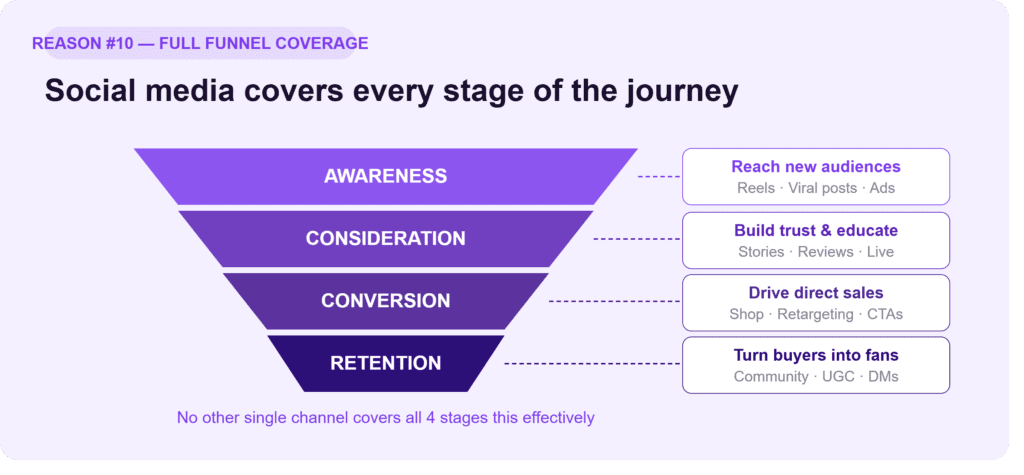
Here’s the big picture that often gets missed: social media isn’t just one tool. It’s a full-funnel marketing system.
At the top of the funnel, it builds awareness — introducing your brand to people who didn’t know you existed.
In the middle of the funnel, it drives consideration — giving people a reason to choose you over alternatives through education, social proof, and relationship building.
At the bottom of the funnel, it triggers conversion — through targeted ads, retargeting campaigns, limited-time offers, and frictionless shopping features.
And after the sale, it enables retention and advocacy — keeping customers engaged, rewarding loyalty, and turning happy buyers into vocal fans who bring you new customers for free.
No other single channel does all of that. Social media is the rare marketing tool that touches every part of the customer relationship.
Common Mistakes That Kill Social Media Marketing Results
Since we’re being real with each other here, let’s talk about what doesn’t work, because plenty of businesses try social media marketing and walk away disappointed.
Inconsistency is probably the biggest killer. Posting three times a week and then disappearing for a month is worse than a slow-and-steady approach. Algorithms reward consistency. Audiences do too.
Treating every platform the same is another common trap. What works on LinkedIn is completely different from what works on TikTok. Each platform has its own culture, format preferences, and audience expectations. A strategy that ignores these differences will underperform everywhere.
Obsessing over follower count instead of engagement and conversion is a mistake that wastes a lot of time and money. A thousand genuinely engaged followers who trust you are worth far more than fifty thousand passive scrollers who barely remember your name.
And finally, not having a clear goal makes it impossible to measure success or improve. Every social media effort should connect to a specific business objective — whether that’s traffic, leads, sales, or brand awareness.
How to Get Started (Or Get Serious) Right Now
If you’re reading this and feeling a mix of excitement and mild overwhelm – that’s completely normal. Social media marketing has a lot of moving parts.
But the best thing you can do is start simpler than you think you need to.
Pick one or two platforms where your audience is most active. Don’t try to be everywhere at once.
Commit to a realistic posting schedule you can actually maintain. Three quality posts per week beat seven rushed ones every time.
Focus on providing value first — education, entertainment, inspiration, honest storytelling. The sales come naturally when trust is built.
Engage with your community like a human being, not a brand robot. Reply to comments. Acknowledge feedback. Start conversations.
Track your results monthly. Look at what’s working and do more of that. Cut what isn’t serving your goals.
And be patient. Social media marketing is not a sprint. It’s a long game — one that rewards consistency, creativity, and genuine connection over time.
Also check: 5 types of social media marketing
Final Thoughts: The Question Isn’t If, It’s How
At this point, the question for most businesses isn’t whether social media marketing is important. That’s been answered clearly, loudly, and repeatedly by the brands that have built empires on the back of it.
The real question is: how well are you doing it?
Because a social media presence done poorly can actually hurt you — inconsistent messaging, unanswered comments, and irrelevant content can make a brand look disorganised or out of touch. But a social media presence done with intention, strategy, and genuine humanity? That’s one of the most powerful growth engines available to any business, at any size, in any industry.
Your audience is there. Your competitors are there. The tools are accessible, the knowledge is available, and the opportunity is very much real.
The only thing left is to show up consistently, authentically, and with something worth saying.
That’s where it all begins.
Found this article helpful? Share it with someone building their brand online — they’ll thank you for it.