15 Proven Social Media Marketing Strategies That Actually Work
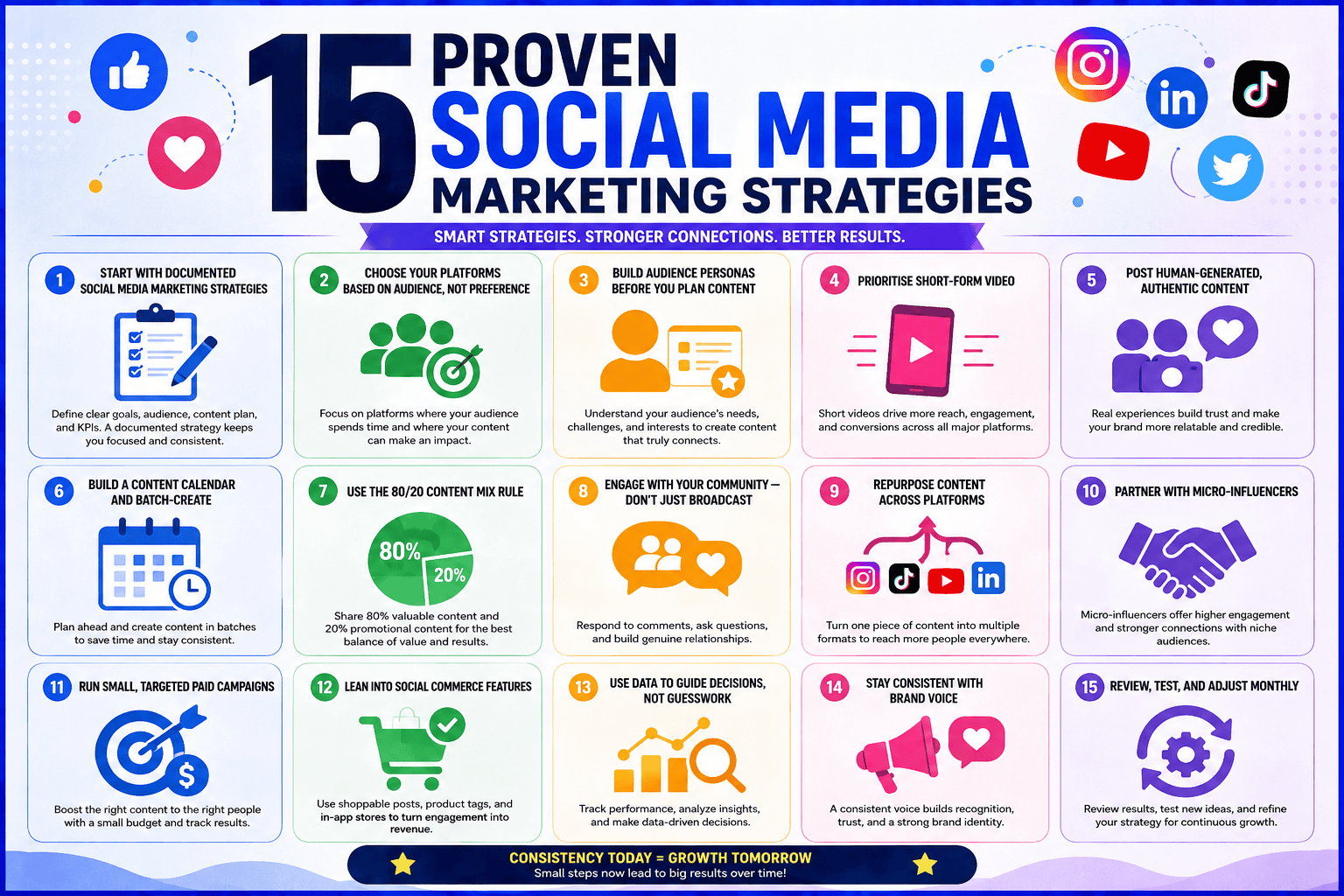
The social media marketing strategies that actually work in 2026 combine a clear platform focus, short-form video, consistent posting backed by data, genuine community engagement, and a mix of organic and paid content — rather than trying to be everywhere at once. Below are 15 strategies, in order of impact, with a practical plan for putting them to work.
Quick Summary Box
- Pick 2–3 platforms based on where your audience actually is, not where you personally prefer to post
- Short-form video and human-generated content are outperforming static posts and polished ad-style content
- Consistency and community management matter more than raw posting frequency
- Combine organic strategy with a small, targeted paid budget for faster results
- Track a handful of KPIs – don’t drown in vanity metrics
Table of Contents
1. Start With Documented Social Media Marketing Strategies
A documented strategy defines your goals, audience, platforms, and content mix in writing — most businesses skip this step and post reactively instead, which is why results plateau.
Before creating a single post, write down your top one or two business goals for social media (leads, brand awareness, and sales), your target audience, your chosen platforms, and your posting cadence. This single document becomes the reference point for every future decision, and it’s the difference between a strategy and a habit.
2. Choose Your Platforms Based on Audience, Not Preference
Go deep on two or three platforms where your specific audience spends time rather than spreading thin content across every network.
Recent research shows brands that concentrate on a few well-chosen platforms consistently outperform those trying to maintain a presence everywhere<cite index=”9-1″>, since businesses that spread themselves too thin across every channel tend to underperform those that go deep on two or three well-chosen ones</cite>. A B2B services firm likely belongs on LinkedIn; a fashion or food brand likely belongs on Instagram and TikTok.
3. Build Audience Personas Before You Plan Content
A persona (age range, interests, pain points, platform habits) keeps content decisions objective instead of based on what the business owner personally likes.
Write one or two personas covering who buys from you, what problem they’re solving, and which platform and content format they respond to. Revisit these personas every few months as your audience evolves.
4. Prioritise Short-Form Video
When planning your social media marketing strategies, short-form video (Reels, TikToks, and Shorts) should be your top priority, as it currently delivers the strongest return of any content format and should anchor your content mix.
Industry data consistently points to short-form video as the top-performing format, with <cite index=”6-1″>short-form video delivering the highest ROI among video formats at 41%</cite>. It doesn’t need to be highly produced—a phone, natural light, and a clear hook in the first three seconds outperform polished but generic content.
5. Post Human-Generated, Authentic Content
Audiences are actively favouring authentic, human-made content over polished or obviously AI-generated posts and will penalise brands that ignore this shift.
This matters for trust as much as reach: <cite index=”6-1″>human-generated content has become the top priority for users in 2026, and a majority of consumers say they will switch to a competitor if a brand doesn’t feel authentic or responsive</cite>. Behind-the-scenes clips, team faces, and real customer moments consistently outperform stock-style content.
6. Build a Content Calendar and Batch-Create
Planning and creating a month of content in one sitting removes the daily pressure to “find something to post” and keeps quality consistent.
Set a recurring weekly or monthly session to plan topics, write captions, and film or design assets in batches. Executing your social media marketing strategies becomes much easier when you batch-create content ahead of time. Tools like Canva (design) and a shared spreadsheet or Notion board (scheduling) are enough for most small businesses to start.
7. Use the 80/20 Content Mix Rule
Roughly 80% of content should educate, entertain, or add value; only about 20% should directly promote your product or service.
Feeds dominated by promotional posts lose followers quickly. Tips, behind-the-scenes content, customer stories, and industry commentary build the trust that eventually makes promotional posts convert.
8. Engage With Your Community — Don’t Just Broadcast
Replying to comments and messages, and engaging with other accounts in your niche, signals to both the algorithm and your audience that you’re an active, trustworthy presence.
Set aside 15–20 minutes daily for replies and community engagement. This single habit consistently correlates with better reach on almost every major platform.
9. Repurpose Content Across Platforms
Smart social media marketing strategies always include content repurposing to multiply output without multiplying effort.
Turn a blog post into a carousel, a quote graphic, and a short video script. This is one of the fastest ways for a small team to sustain a consistent posting schedule.
10. Partner With Micro-Influencers
Smaller, niche-relevant creators often deliver stronger engagement and trust than large influencers, at a fraction of the cost.
The category is proving its value at scale: <cite index=”6-1″>the vast majority of organisations now say influencer marketing outperforms traditional digital advertising, often delivering two to three times the return</cite>. For local or niche businesses, one well-matched micro-influencer often beats a broad paid campaign.
11. Run Small, Targeted Paid Campaigns
A modest, well-targeted Meta Ads or Google Ads budget can accelerate results from your organic content far faster than organic effort alone.
Start by boosting your best-performing organic posts to a tightly defined audience rather than launching cold campaigns from scratch. This is also where working with a specialist — such as Paknook’s Meta Ads and Google Ads services — tends to save businesses from wasted spend during the learning phase.
12. Lean Into Social Commerce Features
In-app shopping tags, product catalogues, and shoppable posts shorten the path from discovery to purchase and are becoming central to platform strategy.
Social commerce is no longer a fringe tactic: <cite index=”4-1″>nearly half of social media users now make purchases directly on these platforms, and social commerce revenue is projected to keep growing sharply through the end of the decade</cite>. Product tagging and a clean shop tab are quick wins for retail and e-commerce brands.
13. Use Data to Guide Decisions, Not Guesswork
Track a small set of KPIs (engagement rate, click-through rate, follower growth, conversions) monthly and double down on what’s working rather than posting on instinct.
Native platform insights, plus Google Analytics for traffic that lands on your site, are enough for most small businesses — no need for expensive enterprise tools early on.
14. Stay Consistent With Brand Voice
A recognisable tone, visual style, and posting rhythm build familiarity, which is what ultimately drives trust and recall.
Document your brand voice in a page or less—three adjectives, a few dos and don’ts—and share it with anyone creating content on your behalf.
15. Review, Test, and Adjust Monthly
Social platforms and algorithms change quickly; a strategy that isn’t reviewed monthly will quietly go stale.
Set a recurring monthly review: what performed, what didn’t, and one thing to test next month. Small, continuous adjustments beat an annual overhaul.
Comparison Table: Which Platform Fits Which Business?
| Platform | Best For | Content Format | Typical Buyer Stage |
|---|---|---|---|
| Retail, food, lifestyle, services | Reels, carousels, stories | Awareness → Consideration | |
| TikTok | Younger audiences, product discovery | Short-form video | Awareness |
| B2B, professional services | Articles, posts, video | Consideration → Decision | |
| Local business, community-driven brands | Mixed, groups, events | All stages | |
| Visual/DIY niches, blogs, e-commerce | Pins, infographics | Awareness → Consideration |
Checklist: Before You Publish Your Next Post
- Does this post fit the 80/20 value-to-promotion mix?
- Is there a clear hook in the first three seconds (video) or first line (caption)?
- Is the format native to the platform (not a re-post of another platform’s format)?
- Does it include a clear next step (comment, save, shop, click)?
- Is it scheduled with time set aside afterward to reply to comments?
Common Mistakes to Avoid
- Trying to maintain five or six platforms at once instead of going deep on two or three
- Posting only promotional content
- Ignoring comments and DMs
- Copying competitor content instead of building an original angle
- Never reviewing performance data
Tools Worth Using
- Canva — design and video templates
- Hootsuite or Sprout Social — scheduling and reporting
- Google Analytics — tracking traffic from social to your site
- Native platform insights — the fastest, free source of performance data
Expert Tip
Treat your first 90 days on any new platform as a research phase. Post consistently, but spend more energy watching what similar accounts in your niche do well than trying to go viral immediately.
Case Example
A small home bakery in Lahore switched from posting polished product photos daily to filming short, unscripted process videos three times a week, replying to every comment within a few hours, and running a small boosted-post budget around Eid and wedding season. Within a few months, engagement and direct message enquiries rose noticeably — without any increase in overall posting frequency.
Frequently Asked Questions
What is a social media marketing strategy?
A social media marketing strategy is a written plan covering your goals, target audience, chosen platforms, content mix, and how you’ll measure success — as opposed to posting reactively without a clear plan.
Which social media platform is best for a small business?
It depends on the audience: retail and lifestyle brands typically do best on Instagram and TikTok, B2B services on LinkedIn, and community-driven local businesses on Facebook.
How often should a business post on social media?
Consistency matters more than volume — three to five quality posts a week on one or two platforms usually outperforms daily posting spread across five platforms.
Do small businesses need paid social ads?
Not immediately, but a small, targeted budget boosting your best organic content tends to accelerate results significantly once your organic strategy is working.
How do you measure social media marketing success?
Track engagement rate, follower growth, click-through rate to your website, and conversions — and review these monthly rather than daily.
Conclusion
None of these 15 social media marketing strategies work in isolation – they compound. A clear platform focus, authentic short-form content, real community engagement, and consistent monthly review will outperform a scattershot approach every time. Start with one or two changes this month rather than trying to implement all fifteen at once.
Not sure where to start, or don’t have the time to execute this consistently? Paknook’s social media marketing and management team can build and run a strategy tailored to your business — from content creation to Meta and Google Ads. Get in touch with Paknook to talk through your goals.